
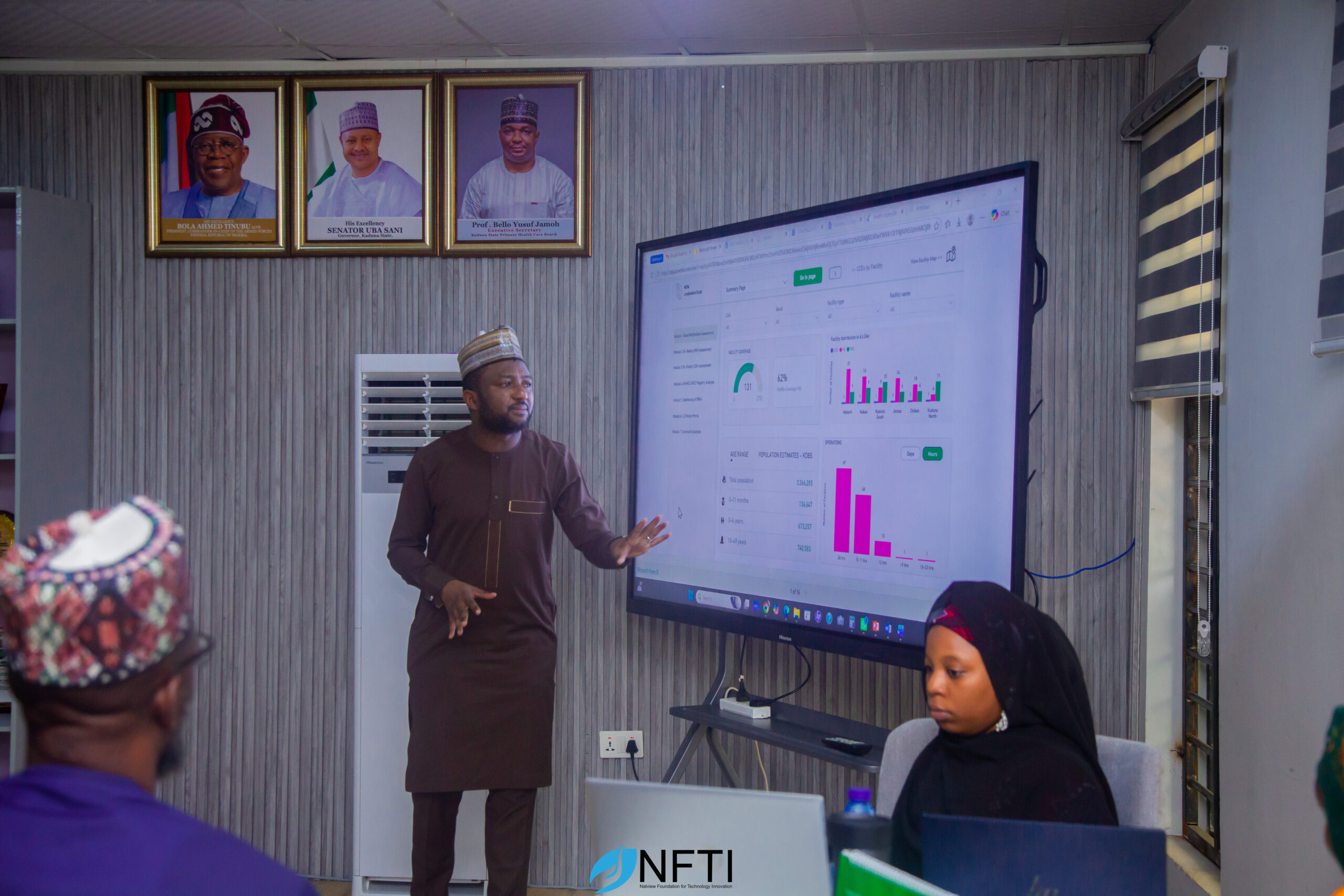
The Natview Foundation for Technology Innovation (NFTI), in collaboration with the Gates Foundation (GF), convened a Longitudinal Study Results Dissemination Session with the Executive Secretary of the Kaduna State Primary Health Care Board (SPHCB), Prof. Bello Yusuf Jamoh, alongside the Board’s directors to present key findings from the Longitudinal Study and discuss evidence-based strategies for strengthening primary healthcare service delivery across Kaduna State.
The session was attended by senior leadership of the SPHCB, including Dr. Maxwell Sandar, Director of Administration and Human Resources; Dr. Dutse M. Gimba, Director of Health Planning, Research and Statistics; Hajiya Nafisah Isah, Director of Community and Family Health; and Abdullahi Musa Garba, Director of Disease Control and Immunization. The results presentation was delivered by the NFTI team—Mr. Nuradeen Maidoki, Chief Executive Officer; Fatima Tafoki; Victor McDickoh; and Salma Hadejia—alongside the Gates Foundation’s Senior Programme Officers, Mr. William Sambisa and Mr. Masduk Abdulkarim.

The dissemination session provided an overview of the Longitudinal Study, highlighting the rationale behind its implementation, its objectives, the methodology adopted, and the scorecard system used to assess primary healthcare facilities. Discussions focused on the evidence generated through the study and how it can inform decision-making for improved health system performance.
Participants examined findings from the study dashboard, which provides near real-time insights into health facility performance across selected primary healthcare centres. The interactive session enabled stakeholders to explore trends, identify performance gaps, and discuss areas requiring immediate intervention.
A major point of discussion was the challenge of primary healthcare facilities that record high patient turnout despite having no permanent staff. Stakeholders explored the implications of this trend on service quality, workforce planning, and the sustainability of healthcare delivery.
The meeting also examined the rural-urban dynamics affecting healthcare service delivery, particularly differences in workforce distribution and facility performance. Discussions further centred on absenteeism and presenteeism among health workers, with participants reflecting on whether the Longitudinal Study’s monitoring approach has contributed to improvements in staff availability.
To further reduce absenteeism, several recommendations were proposed. These included strengthening the verification process for staff absences by requiring supporting documentation for reported reasons, updating duty rosters on a weekly basis to improve accountability, and introducing reliable means of identification to ensure that personnel present at health facilities are those officially assigned to duty.
Responding to questions on the scalability of the Longitudinal Study across all Local Government Areas, the Chief Executive Officer of the Natview Foundation for Technology Innovation (NFTI), Mr. Nuradeen Maidoki, explained that the study is not intended for statistical generalization across every primary healthcare facility in the state. Rather, he noted that the Longitudinal Study adopts a “deep-stick” approach, where a selected number of facilities are monitored closely over time to generate rich, actionable insights. He explained that the evidence generated from these facilities provides a strong basis for understanding systemic challenges and informing policies and interventions that can strengthen primary healthcare delivery across Kaduna State.

In his closing remarks, the Executive Secretary of the Kaduna State Primary Health Care Board, Prof. Bello Yusuf Jamoh, commended the study for its comprehensive approach to assessing health system performance.
He noted that the Longitudinal Study examines critical components of the health system—including the health workforce, essential commodities, and health facility functionality—providing decision-makers with a clear picture of where interventions are most needed. He further emphasized that the evidence generated through the study can be effectively utilized to strengthen primary healthcare services, improve resource allocation, and ultimately contribute to reducing mortality across Kaduna State.
The dissemination session reinforced the importance of data-driven decision-making in strengthening primary healthcare systems. By translating evidence into practical action, NFTI continues to support the Kaduna State Primary Health Care Board and its partners in building a more responsive, accountable, and resilient health system.
