Health systems … operate within dynamic and often unpredictable environments, shaped by shifting disease patterns, economic pressures, and political change. Evidence-based approaches build in continuous monitoring as a matter of design, allowing policymakers to adjust course within months and preventing them from discovering years later that a program has quietly underperformed while resources continued to flow into it.
Ummy, a mother in a remote village, several kilometers from the nearest functioning health facility, notices her infant running a persistent fever. The nearest primary health center is not accessible by road, and by the time she arrives, the one nurse on duty is attending to three other patients with no backup support. There is no electricity to keep vaccines properly refrigerated that week, and the facility’s only community health worker is out conducting immunization outreach in a neighboring settlement, unreachable by phone because there is no network coverage in that area. The mother waits. The child’s fever worsens overnight, and by the time care is finally administered, what should have been a routine, low-cost intervention has become a medical emergency requiring referral to a facility further away, at a cost the family can barely afford.
In Nigeria, this scenario repeats itself, in different forms, across thousands of communities every single day. It is a sad story about how some health systems operate far below their potential, because the system itself has not been built, resourced, or informed in a way that allows it to function as it should. This is the gap between the health system as it exists and the health system as it could be, and closing that gap is one of the most urgent development challenges of our time.
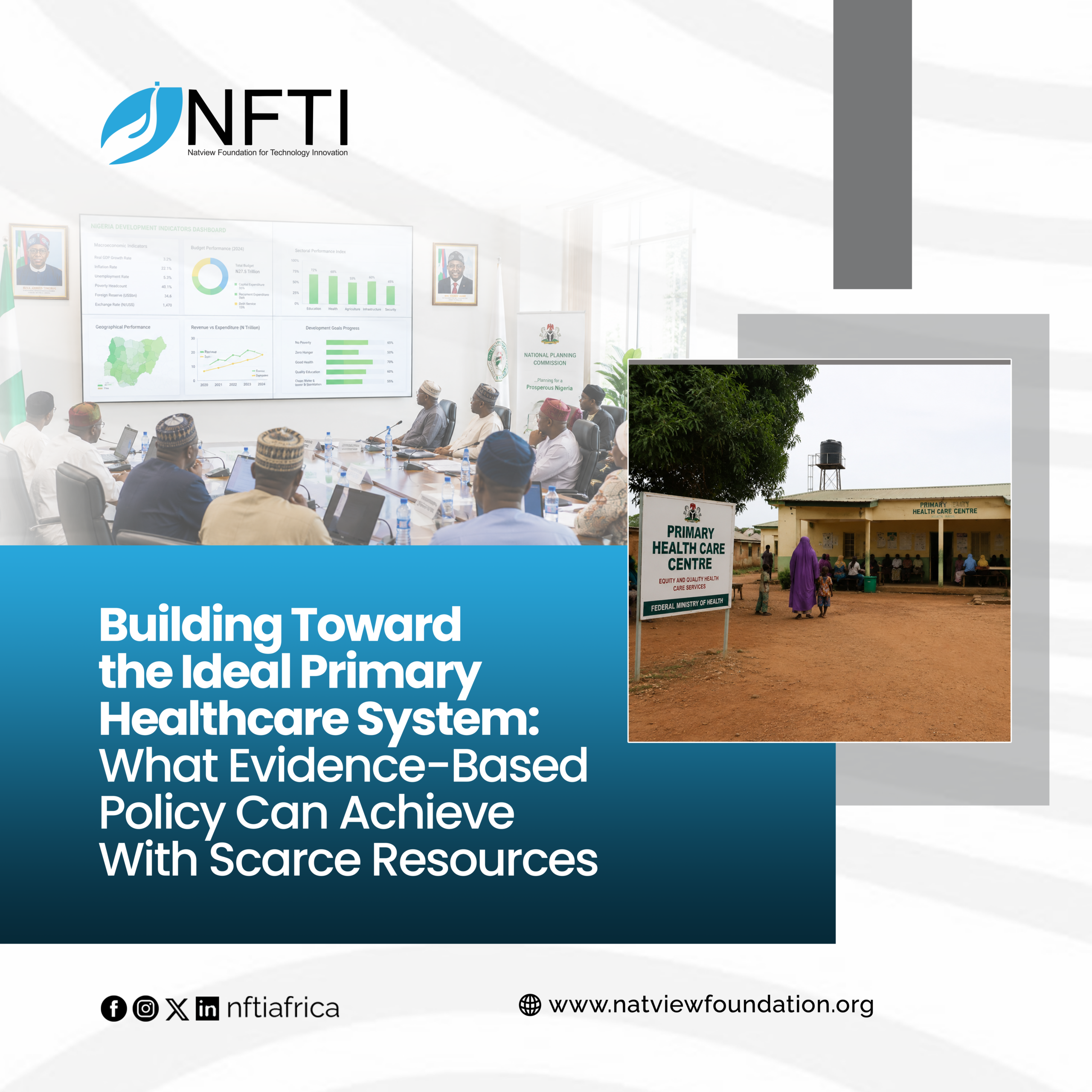
Every health system, no matter how under-resourced, is working toward the same basic promise, that a person can walk into a facility close to home and receive the care they need, when they need it, without it becoming a catastrophic financial or physical burden. This is the essence of primary healthcare, and it remains the most cost-effective entry point for improving population health outcomes, particularly in low-resource settings like much of Nigeria. Yet, as the scenario above illustrates, the distance between this ideal and the lived reality on the ground remains wide. Facilities are underfunded, health workers are stretched thin across impossible caseloads, supply chains break down without warning, and the data systems needed to tell decision-makers what is actually happening on the ground are often too weak, too slow, or too disconnected from the communities they are meant to serve.
The question then is not whether resources are scarce, they are, and in most low- and middle-income contexts, they will likely remain so for the foreseeable future, regardless of how much advocacy is directed at increasing health budgets. The more useful and more answerable question is how a society makes the most of what it already has. This is precisely where evidence-based policymaking becomes indispensable.
An ideal primary healthcare system rests on a handful of interlocking foundations. Care must be genuinely accessible, available within a reasonable distance and at a reasonable cost, including for the rural and hard-to-reach communities that are so often an afterthought in health planning. Services must be continuous and integrated so that a patient’s journey from prevention to treatment to referral does not break down the moment they move from one level of the system to another. The workforce, from doctors to community health workers who are so often the first and only point of contact for rural families, must be adequately trained, fairly distributed, properly supported, and given a reason to stay in the system rather than leave it. Essential medicines, commodities, and basic infrastructure such as electricity, clean water, and connectivity must be reliably available, not something facilities hope for. Underlying all of this, the system needs strong data and accountability mechanisms so that decision-makers can see, in near real time, what is actually happening on the ground and act on that information before small problems become large ones. And finally, the system must retain the trust and active engagement of the communities it serves, reflecting their needs rather than only the priorities of whoever happens to be funding or managing it.
No health system anywhere in the world, including those in wealthy countries with far greater resources, achieves all of this perfectly. But these foundations offer a useful benchmark against which progress can be honestly measured, and they help clarify where scarce resources should be directed for the greatest possible return. This is the heart of the matter. When budgets are effectively unconstrained, inefficiency is costly but survivable. When resources are scarce, as they are across most of the health systems NFTI works within, every misallocated program, every unproven intervention pursued on assumption rather than evidence, and every initiative rolled out without proper monitoring carries a far higher cost than it would in a better-resourced environment. Evidence-based policymaking enables governments and their partners to prioritize interventions that deliver the greatest impact for the resources invested, rather than spreading already limited resources thinly across every competing demand that arises.
In practice, this begins with data-driven prioritization and not assumption. Evidence-based approaches use disaggregated data, broken down by location, demographic group, and disease burden, to direct resources toward where they will have the greatest effect. This has proven particularly important in maternal and child health, immunization coverage, and communicable disease control areas, where targeted investment consistently and measurably outperforms broad, unfocused spending spread evenly across a population regardless of actual need.
It also means favoring the discipline of piloting before scaling. It is inefficient to commit significant resources to an intervention because it sounds promising or has worked elsewhere, evidence-based policymaking on the other hand tests approaches at a smaller scale first, monitors outcomes rigorously, and only scales what has demonstrably worked in the specific context where it is being applied. This reduces the very real risk of investing heavily in an approach that looks good on paper but fails to translate into measurable improvements in access or outcomes once it meets the realities of a particular community, culture, or health system.
Health systems, like the communities they serve, do not stand still. They operate within dynamic and often unpredictable environments, shaped by shifting disease patterns, economic pressures, and political change. Evidence-based approaches build in continuous monitoring as a matter of design, allowing policymakers to adjust course within months and preventing them from discovering years later that a program has quietly underperformed while resources continued to flow into it.
Perhaps most critically, evidence-based policymaking shifts the underlying culture of health governance away from reporting for its own sake and toward using data to drive tangible improvements in service delivery. When governments, development partners, and the communities they serve can track progress against clear, shared indicators, there is a far stronger basis for honest course correction and for holding every part of the system accountable to the people it exists to serve.
Returning to the mother and her feverish child, it is worth imagining what an evidence-informed system might have offered her instead. A facility staffed and equipped based on documented patient load and disease patterns in her area, instead of a fixed allocation applied uniformly regardless of local need. A cold chain monitored through simple, low-cost sensors that flag problems before vaccines spoil. A community health worker deployment schedule built around actual movement and coverage data, so outreach and facility duties do not compete on the same day. None of these are expensive innovations. None require abandoning the reality of scarce resources. What they require is a system willing to be guided by evidence and a set of decision-makers with the data and the will to act on what that evidence shows.
No health system will close the gap between the ideal and the actual overnight, and the scarcity of resources that defines so much of the development landscape is unlikely to disappear soon. But evidence-based policymaking offers a genuinely practical pathway forward.
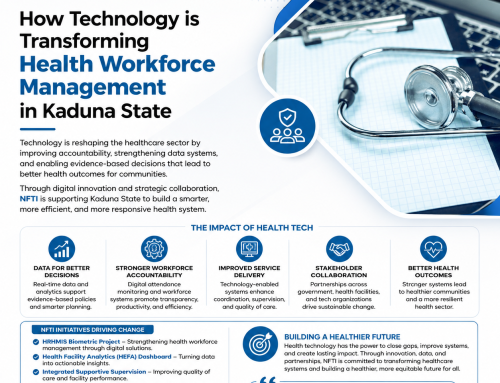
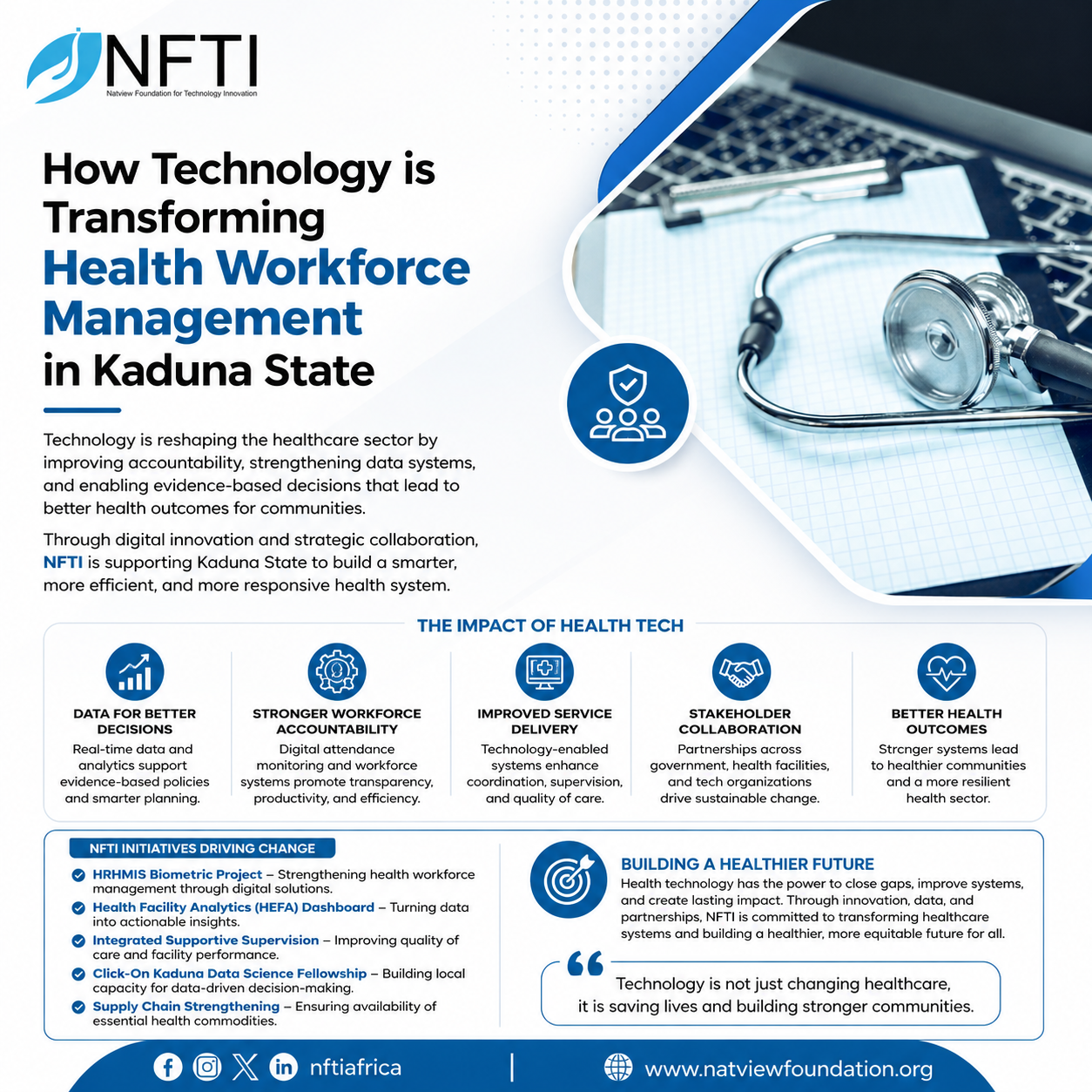
This is the thinking that underpins NFTI’s approach to health systems strengthening work, pairing data, technology, and rigorous evidence with the practical realities of resource-constrained environments. It is reflected in the work already underway in some Nigerian States.
Through an ongoing longitudinal study, NFTI is systematically tracking the readiness of primary health facilities across Kaduna State, generating repeated rounds of operational data on human resources for health and supply chain management to identify and address gaps before they compound into crises.
The project is deliberately participatory, not extractive. What do I mean? With peer review sessions held directly with health facility in-charges and local government health officials, after a few rounds of longitudinal visits, findings are validated, local capacity is built, and the resulting recommendations are grounded in the realities frontline health workers actually face.
In Kano State, NFTI has also applied geospatial technology and data-driven microplanning to help policymakers identify underserved areas and direct maternal, newborn, and child health resources where they are needed most.
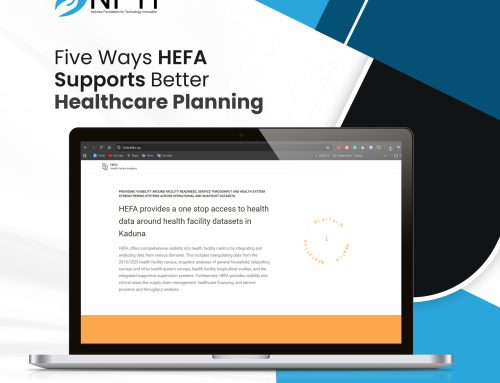
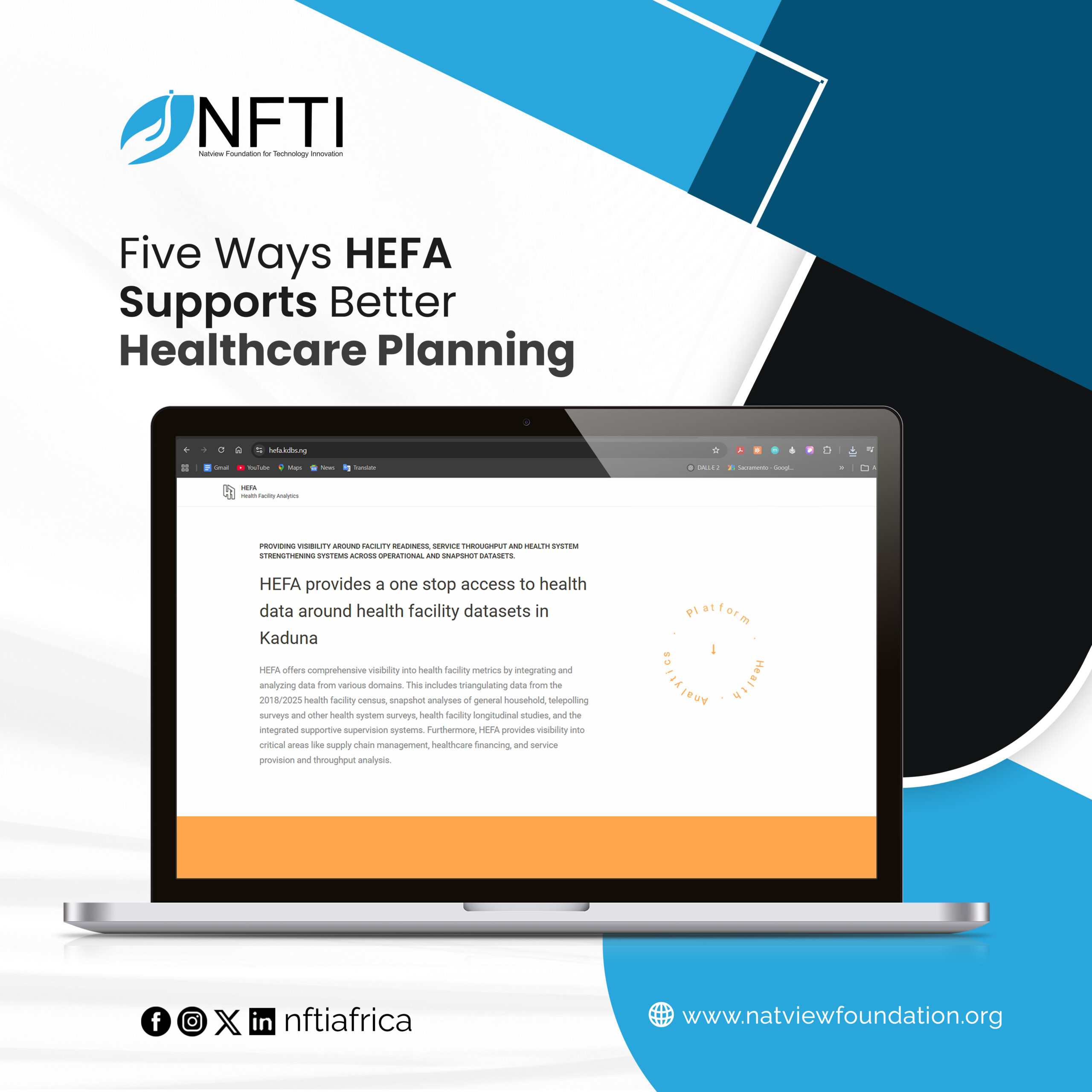
The Health Facility Analytics platform, known as HEFA, was developed by NFTI under the Kaduna State Data Lab and built on the foundation of the Kaduna State Health Facility Census, conducted by the Kaduna State Bureau of Statistics. HEFA takes what were once scattered, difficult-to-use health facility datasets and cleans, analyzes and transforms them into a single interactive dashboard suited for real policy analysis and decision-making, accessible not only to government officials but to healthcare providers, researchers, and members of the public who want to understand the state of healthcare where they live. HEFA has continued to evolve, integrating additional data sources such as the Integrated Supportive Supervision data and the Kaduna State General Household Survey to build an increasingly holistic picture of health system performance over time. It is one of the state’s proven data-driven interventions, with lessons from its design carried forward into NFTI’s subsequent longitudinal facility readiness study. In practical terms, HEFA is evidence-based policy making made visible and usable, giving planners in a resource-constrained state the ability to see where facilities are underperforming, where health financing is failing to reach the point of care, and where the next well-informed policy choice should be made.
The ideal primary healthcare system described in this article may still be some distance away for many of the communities we work alongside. But with the right evidence guiding the right decisions, it becomes a destination that societies can actually move toward and one fewer preventable emergency for mothers like Ummy.